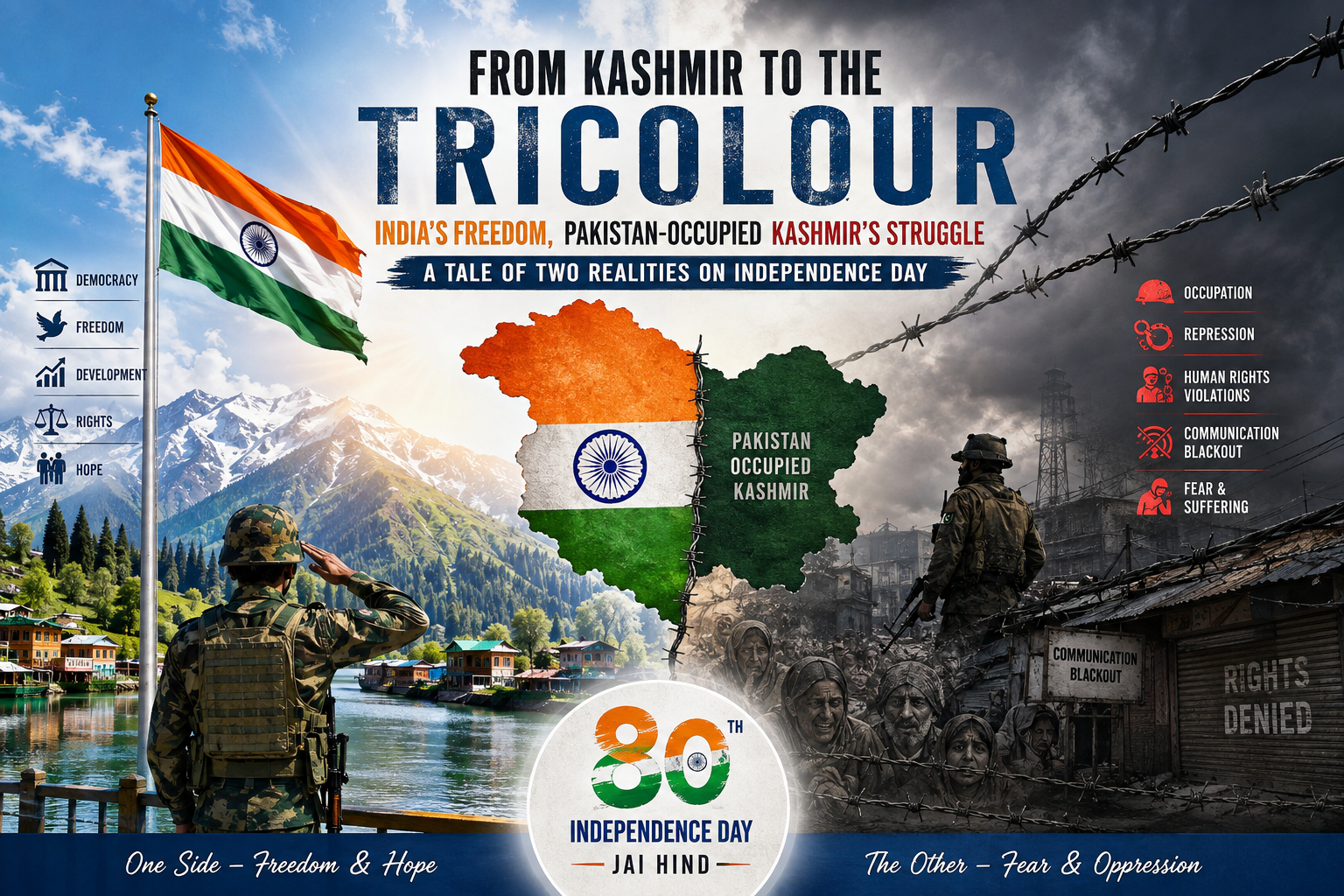
From Kashmir to the Tricolor: India’s Freedom, Pakistan-Occupied Kashmir’s Struggle — A Tale of Two Realities on Independence Day.
Sheikh Minhaj
As India celebrates its 80th Independence Day, my heart is filled with an emotion that words can scarcely contain—a profound sense of gratitude, pride and belonging. I feel deeply fortunate to have been born in India, a nation whose journey from colonial subjugation to a confident, democratic and rising power has been written with the sacrifices of millions. For me, Independence Day is not merely a celebration; it is a moment to remember those who gave us freedom, those who continue to defend it and the values that make India worth protecting.
And for someone who belongs to Kashmir, the meaning of this day carries an even deeper emotion.
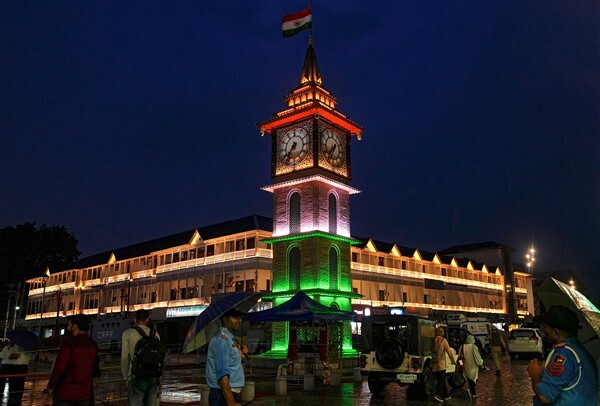
Kashmir has witnessed the consequences of conflict, terrorism and uncertainty for decades. Its mountains have seen the courage of soldiers, its villages have known the pain of violence, and its people have experienced both the darkness of terrorism and the hope that peace and development can bring. Therefore, when the Tricolour rises over the Valley, it is not simply a flag being hoisted—it is a reminder of India’s constitutional promise, its democratic character and the sacrifices made to safeguard its unity.
With all my heart, I extend my love and affection to my motherland, to its people and, above all, to the brave men and women of our Armed Forces and security forces who stand on the frontlines so that millions of Indians can live their lives in peace and freedom. From the icy heights of the Himalayas to the deserts of the western frontier, from difficult border posts to challenging theatres of internal security, our soldiers and security personnel have served with extraordinary courage and devotion.
Many never returned home.
Their families continue to carry the weight of their absence while carrying their memories with immense pride. Their sacrifice must never become an ordinary line in a history book. Every time the Tricolour rises, every Indian must remember that there are families who sacrificed their sons and daughters so that the rest of us could live without fear.
India’s freedom itself came at an enormous price. Generations of freedom fighters endured imprisonment, persecution, suffering and death to free the country from colonial rule. Their sacrifices gave birth to an independent India. After 1947, the responsibility of protecting that freedom passed to the men and women in uniform. Their battlefield changed, but their duty remained the same: to protect India.
This Independence Day also carries the pain of remembering innocent civilians who have fallen victim to terrorism. The Pahalgam terrorist attack of April 22, 2025, in which 26 people were killed, remains one of the most painful reminders of the human cost of terrorism. Families were shattered, lives were destroyed and an entire nation was forced to confront once again the brutal reality of terrorism.
India’s response through Operation Sindoor demonstrated the country’s resolve and determination to confront terrorism and protect its citizens. For me, Operation Sindoor represents a clear message: the lives of innocent Indians matter; terrorism cannot be allowed to become an instrument of permanent intimidation; and the nation will stand firmly behind those who defend its sovereignty and its people.
I salute the courage and professionalism of our security forces. I bow before the families who lost their loved ones to terrorism. Their pain deserves remembrance, their sacrifices deserve respect and their stories deserve to be remembered whenever we speak of India’s freedom and security.
But Independence Day must also make us look beyond our own borders and reflect upon the condition of people who continue to suffer because of conflict and political instability.
The situation in Pakistan-occupied Kashmir deserves serious attention from the international community. Reports of deaths, disappearances, restrictions on communication, economic hardship and shortages of essential services have raised serious concerns regarding the rights and welfare of ordinary people. Whatever the political circumstances, no ordinary citizen should have to suffer because of conflict, repression or instability.
The people living in Pakistan-occupied Kashmir deserve dignity, justice, fundamental rights and the opportunity to live without fear. Their grievances deserve to be heard. Their hardships deserve attention. Credible allegations of human-rights violations must be investigated impartially, and international forums must ensure that the voices of affected civilians are not silenced.
For me, this comparison is particularly important for Kashmir.
We must recognise the immense value of living in a democratic and constitutional India. Freedom should never be taken for granted. The right to vote, the right to education, the right to seek justice, the right to express oneself, the right to participate in democratic institutions and the right to aspire for a better future are not small privileges. They are the foundations of a free society.
Freedom is not simply the absence of foreign rule. Freedom means being able to live without fear, to speak without intimidation, to pursue one’s aspirations, to receive justice and to participate meaningfully in the political, social and economic life of one’s country.
That is the India I am proud of.
That is the India I want Kashmir to experience even more deeply.
And that is the India I want to see becoming stronger every single day.
India’s greatest strength is not merely its military power, economic progress or technological achievements. Its greatest strength is its democratic spirit and its extraordinary diversity. From Kashmir to Kanyakumari, from Gujarat to the Northeast, Indians speak different languages, follow different traditions and practise different faiths, yet stand beneath one Tricolour and share one constitutional identity.
For Kashmir, the future must be about peace, opportunity, education, tourism, employment, development and dignity. The people of the Valley deserve a future in which young minds dream of universities and enterprises rather than violence; in which children grow up seeing the uniform as a symbol of security rather than fear; and in which the beauty of Kashmir becomes known to the world not because of conflict, but because of its people, culture, hospitality and extraordinary natural heritage.
Our answer to terrorism must remain firm.
Our answer to hatred must be unity.
Our answer to division must be democracy.
Our answer to injustice must be the rule of law.
And our answer to every challenge must be a stronger, more confident and more compassionate India.
On this Independence Day, my first tribute is to our soldiers and security personnel who have made the supreme sacrifice. I salute every family that has sent a son or daughter to serve the nation. I remember every innocent civilian killed by terrorism and violence. I extend my deepest sympathies to their families and salute India’s determination to defend its people.
As the Tricolour rises on August 15, I will look at it with pride. I will see in it the dreams of our freedom fighters, the courage of our soldiers, the resilience of our citizens and the aspirations of our children.
I will see Kashmir too—not as a symbol of conflict, but as an inseparable and beautiful part of India’s national story; a land whose people deserve peace, prosperity, dignity and opportunity.
I feel fortunate to be an Indian.
I feel proud to be an Indian.
And on India’s 80th Independence Day, my message is simple: let India remain strong enough to defend itself, democratic enough to hear its people, compassionate enough to remember every victim and determined enough to ensure that the next generation inherits not the conflicts of the past, but the possibilities of a peaceful, prosperous and powerful future.
Let Kashmir prosper in peace.
Let the Tricolour fly high across every corner of the nation.
Let the sacrifices of our soldiers never be forgotten.
And let the India we build be worthy of the courage of those who gave everything for the Nation.